FLAG

Libyan Arab Air Force aviation units at
Tripoli International Airport
Earlier airport names:
Tripoli Idris International Airport
RAF Idris Airport
RAF Castel Benito Airport
Tripoli-Castel Benito Airport
The Libyan capital of Tripoli had two major airports in the second half of the 20th century. These two airports are often confused in Western aviation literature, but also frequently in Eastern literature. Let's take a look at the military history of Tripoli International Airport.
The airport was built by Italian colonists in the 1920s. After World War II, the airport was used by the British.. The British expanded it and renamed it RAF Idris in honor of the Libyan king.
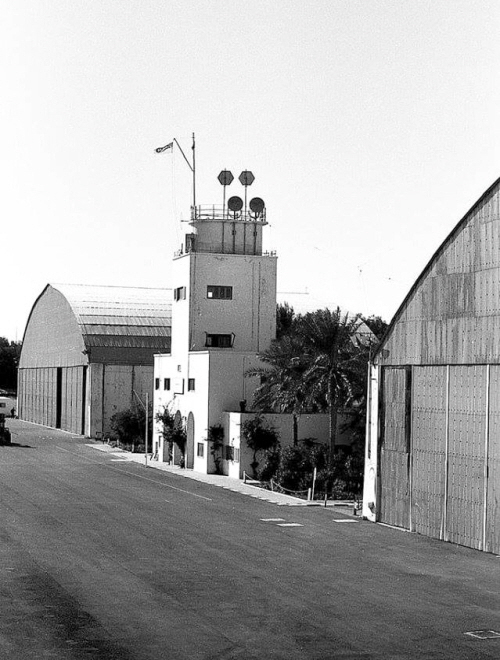
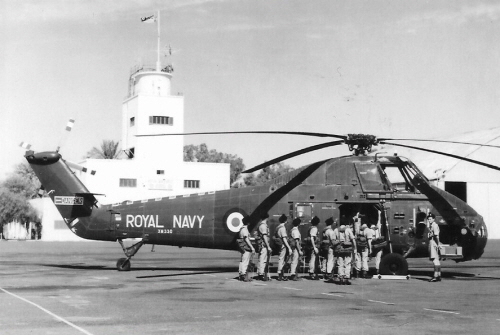
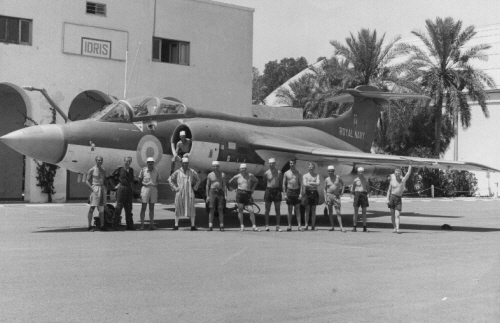
The Royal NAVY's Westland Wessex helicopter and Blackburn Buccaneer attack aircraft in front of the RAF Idris airport old tower.
In the 1950s and 1960s, the RAF Idris airport was used as a staging post for civil and military flights to and from the United Kingdom to the Middle East and Far East. And Royal Air Force and Royal NAVY aircrafts and helicopters used the local gunnery range at El Uotia and Tarhuna in the desert.
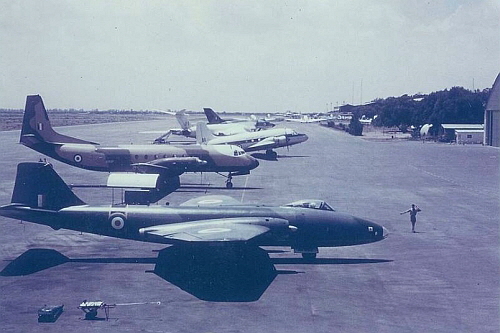
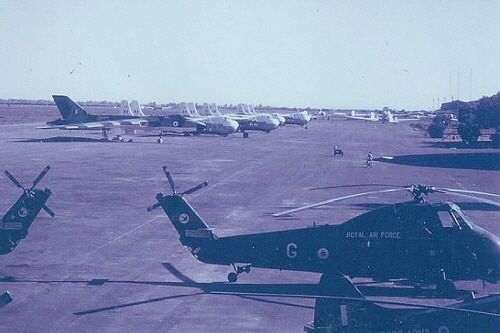
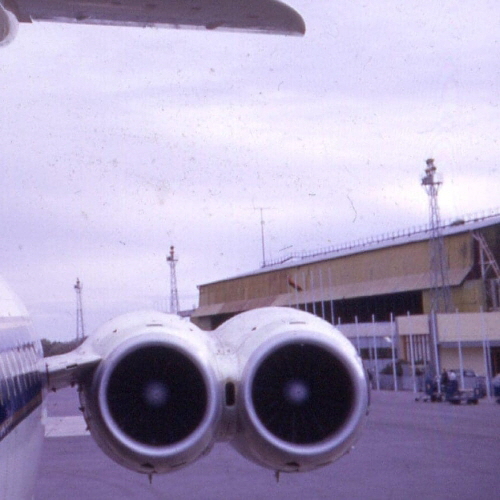
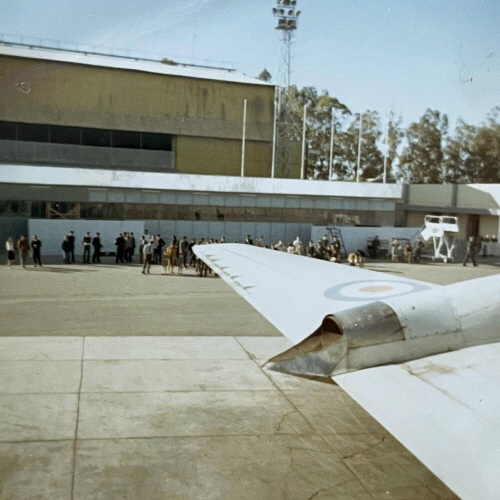
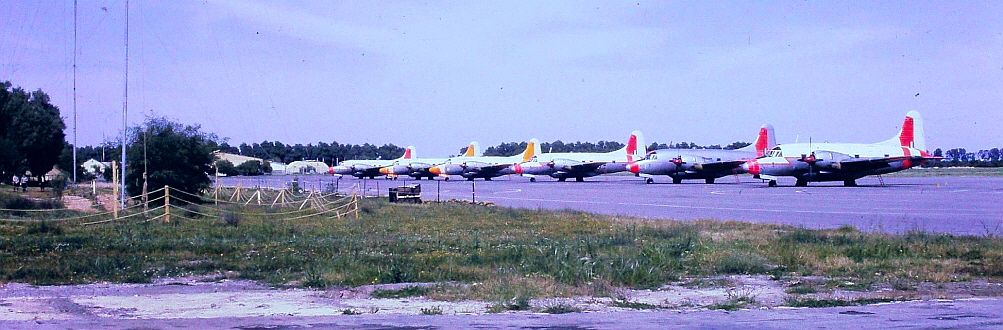
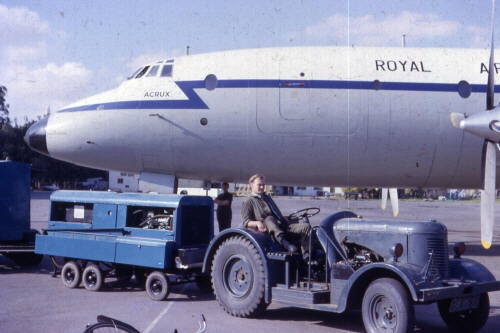
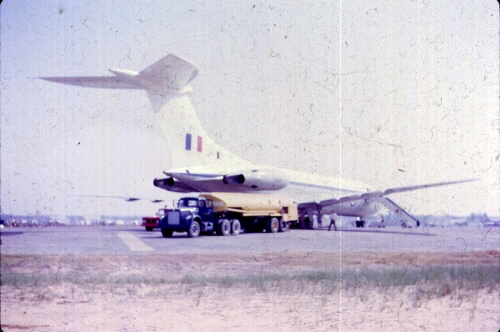
RAF Transport Command's Bristol Britannia and Vickers VC10 at Libyan RAF Idris airport. Photos source: RAF Idris FB Group
After the Libyan revolution, the the British withdrew from the country and RAF Idris airport was handed over to the Libyan Arab Republic in September 1969.
1970-1980 period - Tripoli International airport
In the first half of the 1970s, it continued to receive international and domestic civilian flights under the name Tripoli International Airport, and the Libyan Arab Air Force also stationed its new French and Italian-made helicopters there.
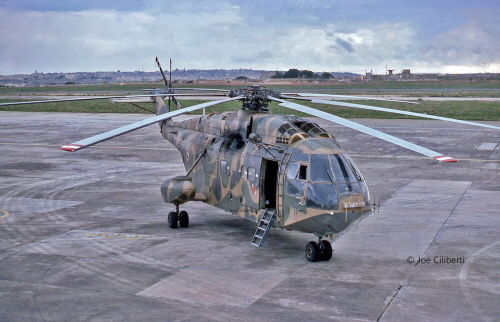
France delivered nine SA 321M Super Frelon and four SA 316B Alouette III helicopters to Libya between 1971 and 1972. The photo was taken of an 1345th Squadron’s SA 321M Super Frelon helicopter in Malta. Photo: Joe Ciliberti
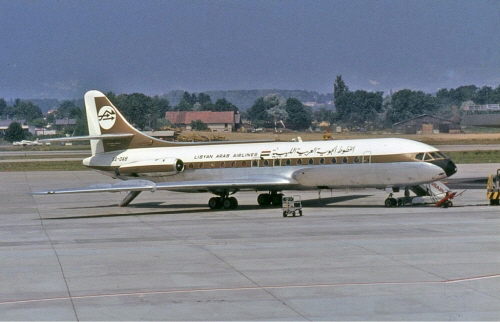
In the first half of the 1970s, Libyan Arab Airlines flew Sud Aviation Caravelle, Fokker F27, and Boeing 727-200 airliners from Tripoli International Airport. The photo was taken of a Libyan Arab Airlines Caravelle airliner at Geneva International Airport in 1971. Photo: Clinton H. Groves
In the early 1970s, two new helicopter squadrons were created for the new helicopters. The 1345th Squadron received the bigger three-engined heavy transport SA 321M Super Frelon helicopters. Meanwhile, the smaller capacity French SA 316B Alouette III light utility helicopter and a few Italian made AgustaBell 206/205/212 helicopters belonged to the new 1315th Squadron. The French manufacturer set up industrial support capacity for these helicopters at Tripoli International Airport.
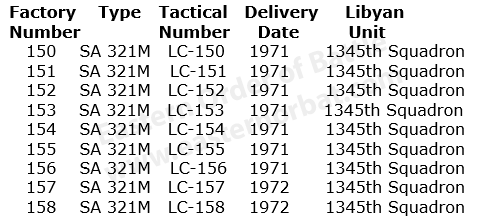
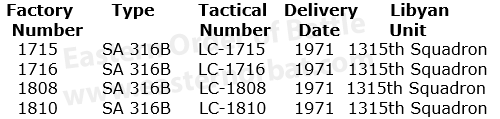
The 1345 and 1315 Helicopter Squadrons performed search and rescue missions from Libyan airfields. Then, in 1975 the form of the Libyan Military Mission In Malta with a contingent of two Aerospatiale SA 321M Super Frelon helicopter. The Libyan SAR helicopters were flown by a Libyan crew but were supplemented by Maltese rear crew members.
Due to increased demand, additional helicopters were ordered from France. Aerospatiale delivered 14 more SA 316B Alouette III light helicopters to Libyan 1315th Squadron in 1976.
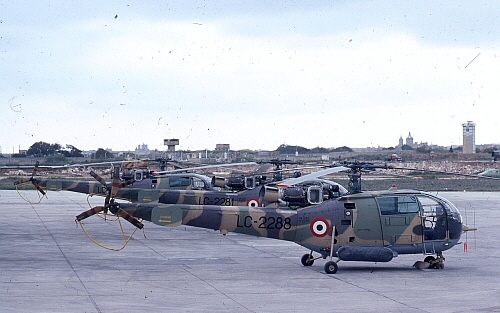
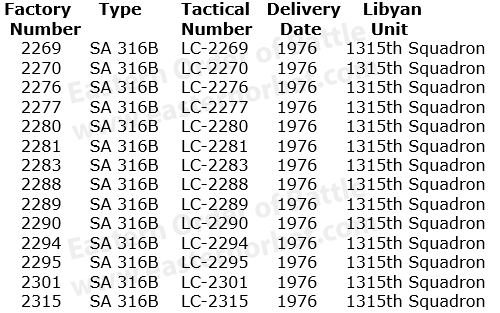
Libyan Arab Air Force aviation units at Tripoli International Airport in 1976-1977:

In the mid-1970s, construction began on a completely new international terminal that met the needs of the time. The new terminal was opened in 1978 to replace the old Italian/British buildings nearby. The old terminal building continued to be used for air cargo and passenger transport operations.
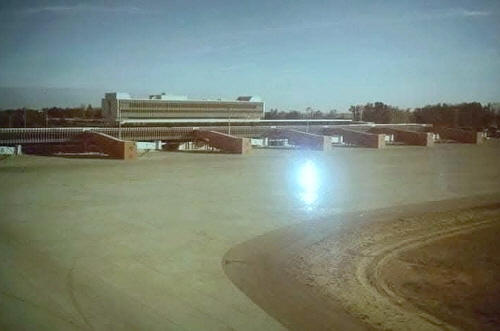
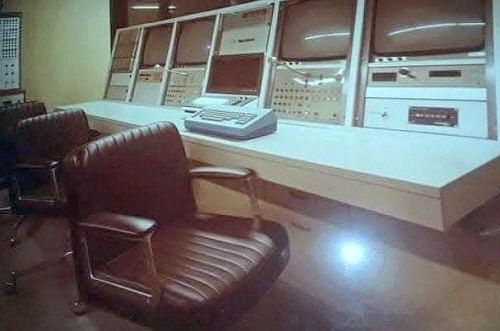
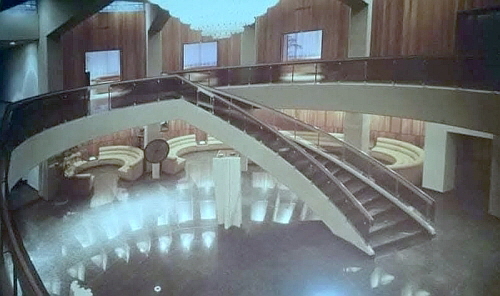




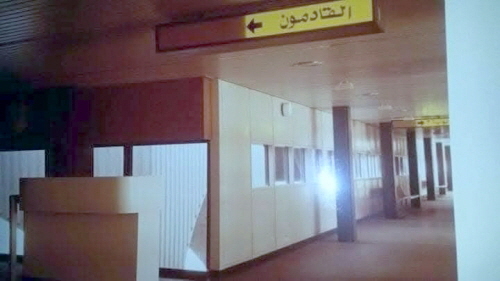
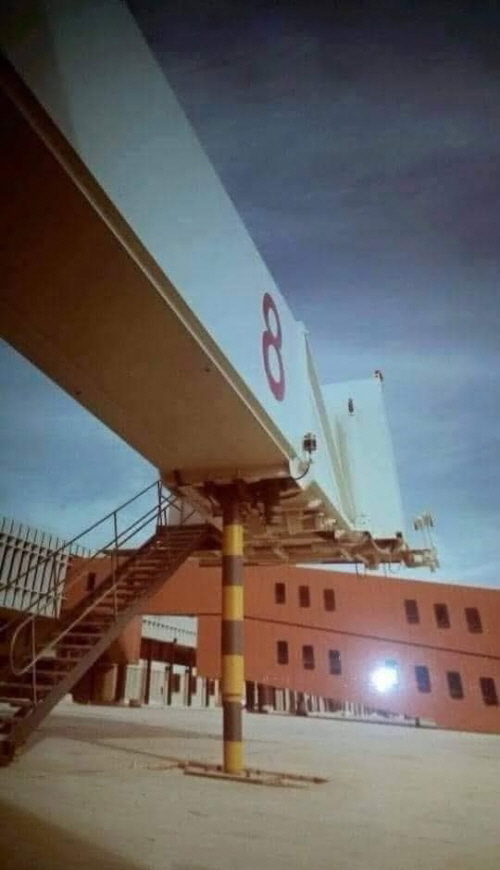
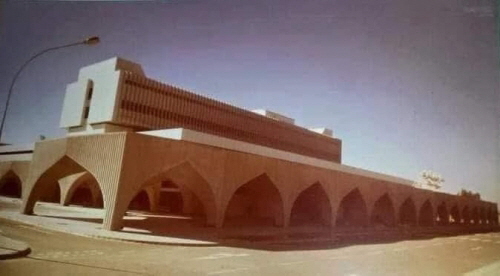
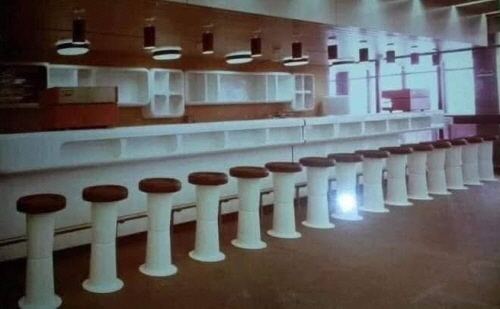
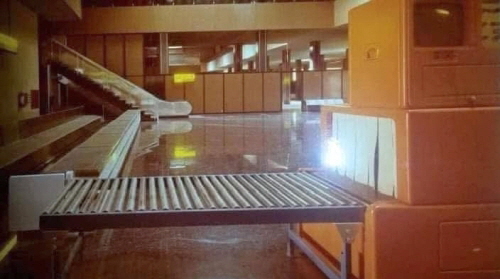
The new international terminal at Tripoli International Airport upon its opening in 1978.
Source: ليبيا قبل وتوا - Libya before and now FB Page
At the end of the 1970s, three new military types arrived at Tripoli International Airport.
Twenty Meridionali-Boeing CH-47C Chinook:
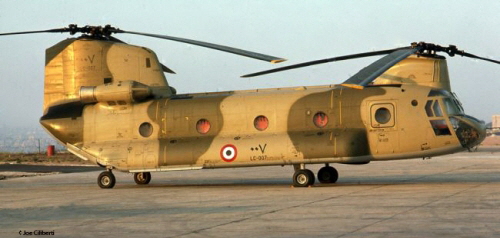
In 1976, Italy signed several major arms contracts with Libya, including one for the delivery of 20 Italian-built versions of the CH-47C Chinook produced under licence by Meridionali-Boeing. These were delivered between 1977 and 1980 and formed Chinook Squadron based at Tripoli International airport. The serial numbers of the helicopters ranged from LC-001 to LC-020
Photo: The LC-007 early Libyan CH-47C Chonook at Malta in 1977. Photo: Joe Cilibert
In 1979, a other new type arrived at the rebuilt Tripoli International Airport. Libya purchased five IL-76M military four-engine heavy air cargo aircraft from the Soviet Union. Libyan personnel traveled to Ivanovo north of Moscow, Soviet Union, in 1979 for reconversation training. The large team consisted of seven pilots and flight engineers, radio operators, navigators, maintenance personnel. All of them had previously gained experience on C-130 Hercules transport or Tu-22 ’Binder’ bomber aircraft.
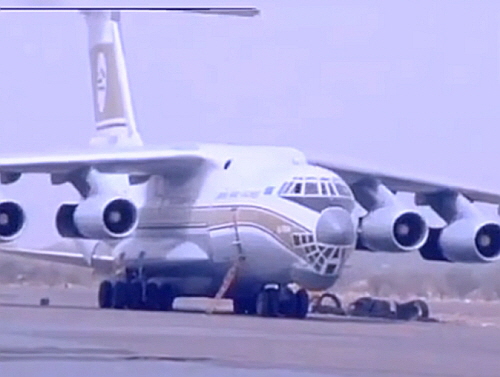
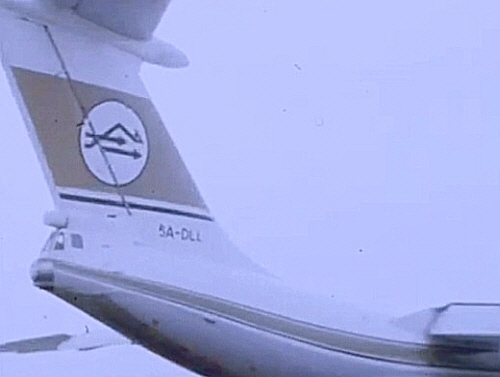
These military IL-76M variants still had a gunner's turret at the rear of the aircraft. Photos: AP
The first retrained personnel returned to Libya in early 1980 to form the 1276th Squadron at Tripoli International Airport. They were welcomed at the airport by three IL-76M 'Candid' military transport versions and two Soviet retraining crews. The retraining of the Libyan crew was assisted by this two Soviet crew in Libya.
The first military task of the 1276th Squadron was to transport military equipment to Syria. After the Israeli-Syrian clashes in 1980, Libyan leader Gaddafi promised to make up for Syria's losses. In 1980, Libyan IL-76M "Candid" aircraft transported military equipment to Syria during for a month, including MiG-23MS ‘Flogger-E’ fighter jets from Benina airport. These missions remained memorable for the Libyan crew because the transfer of weapons was not supported by the Soviet Union, so they flew in international airspace over the Mediterranean for the first time without Soviet crew support.
In the meantime, two more IL-76Ms arrived from the Soviet Union for the 1276th Squadron, bringing the number of available aircraft to five by the second half of 1980. The Libyan Air Forces’s IL-76Ms flew with the civilian markings of Libyan Arab Airlines.
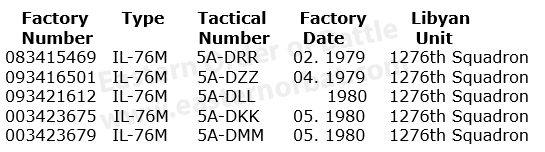
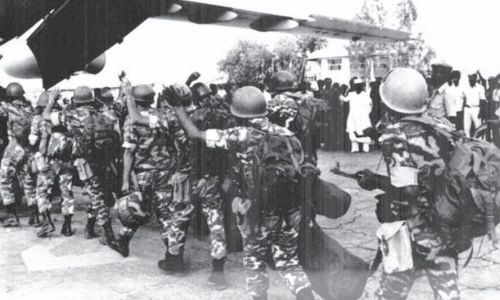
The new models were deployed almost immediately in the war in Chad, Libya. The IL-76M models played a key role in supporting the Libyan forces.
Meanwhile, Chinook helicopters provided direct support to army forces. Unfortunately, at that time, there were not enough personnel for the new models. For example, in 1980 there were only 14 pilots available for the twenty Chinook helicopters. Therefore, in the early 1980s, Western pilots were recruited to fly the Libyan Chinook helicopters over Chad.
Video
Libyan troop withdrawal from Chad in 1981 with 1276th Squadron’s Libyan IL-76M ‘Candid’ heavy transport aircrafts.
Between late 1980 and early 1981, six more Super Frelon helicopters arrived in Libya. These were radar-equipped SA 321GM anti-submarine helicopters.
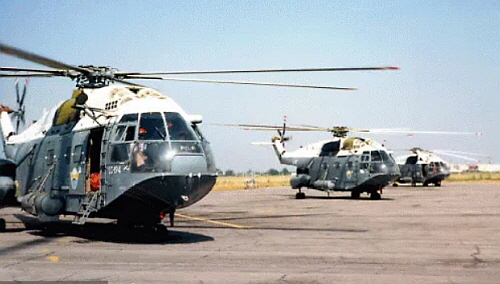
Libyan SA 321GM Super Frelon SAR/ASW helicopters
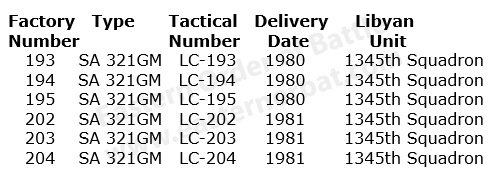
At the time of their delivery, relations between Malta and Libya deteriorated and in 1980 the Libyan SAR contingent was excluded from Malta. Then, between 1981 and 1983, the Soviet Union delivered thirty Mil Mi-14PL 'Haze-A' helicopters too with similar capabilities to Libya.
As a result, the Libyan Super Frelon helicopters were confined to the Tripoli area in the eighties. Of the ten-year-old older SA 321M models, only four remained (four crashed in the 1970s of the original nine and one returned to France). These were joined by six new SA 321GM version stationed at Tripoli International Airport on the 1345th Squadron in the eighties
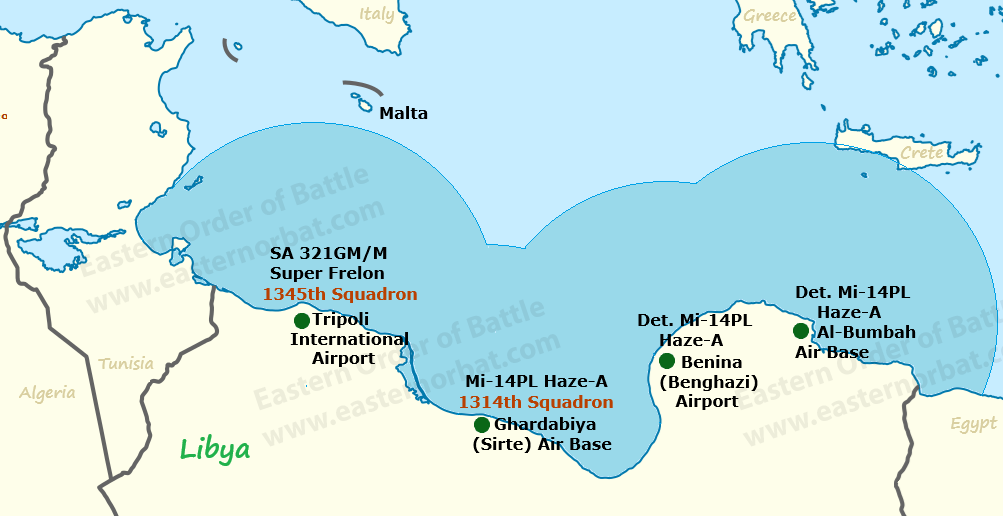
Major Libyan SAR bases and their patrol areas over Libyan coastal waters in the first half of the 1980s. While the 1315th Squdron's smaller SA 316B Alouette III light helicopters provided SAR services in the country's interior, all the way to Ozo Airport, which liesed just across the border with Chad.
Libyan Arab Air Force aviation units at Tripoli International Airport in 1980:

1981-1987 period - Tripoli International airport
At the end of the 1970s and beginning of the 1980s, one hundred military helicopters arrived in Libya:
-
SAR role: Fifty SA 321GM Super Frelon / SA 316B Alouette III / Mi-14PL ‘Haze-A’ search and rescue helicopters from France and the Soviet Union.
-
Army support role: About fifty CH-47C Chinook / Mi-24A/D ‘Hind-A/D’ helicopters arrived from Italy and also from the Soviet Union to support the Libyan Army units.
However, the Libyan Arab Air Force's transport tasks were not previously supported by helicopters. Therefore, in the early 1980s, forty Mil Mi-8T ‘Hip-C’ medium helicopters were ordered. Known Libyan Mi-8T ‘Hip-C’ serials:
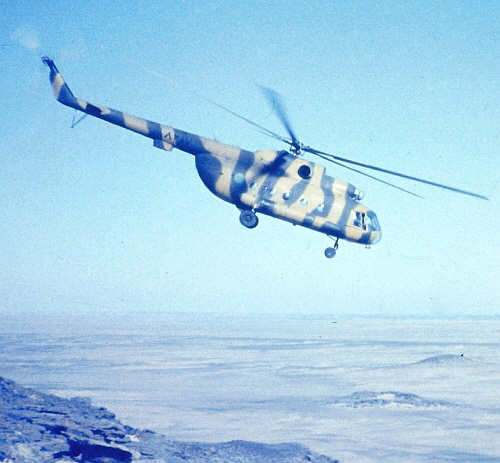
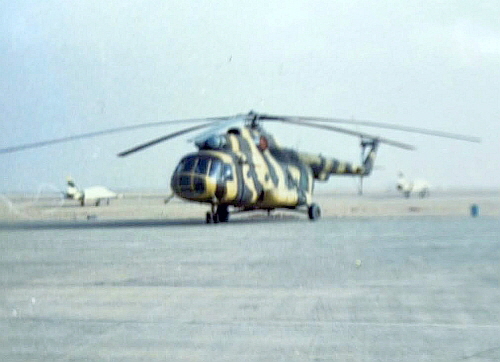
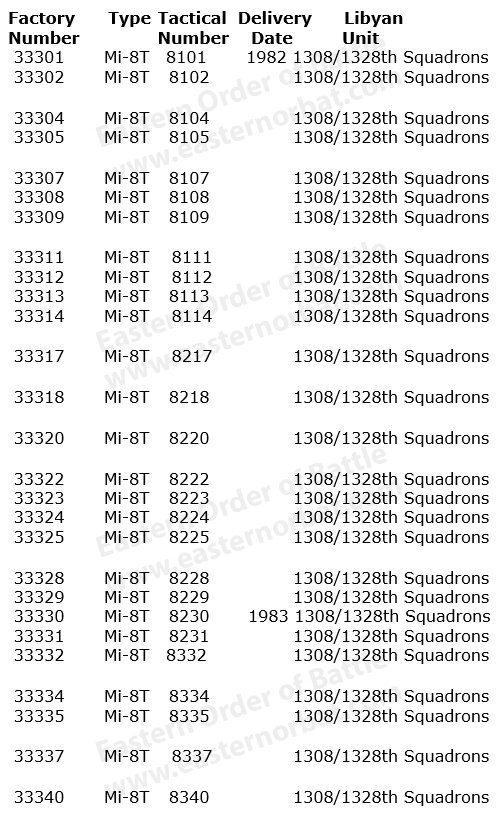
In 1982 Libyan personnel traveled to the Aeroflot Mi-8 training school in Ukrainian SSR. The Libyan Arab Air Force established two new helicopter squadrons for the Mi-8s in 1983. The 1308th Squadron operated in eastern Libya at the Benina, Al-Bombah, and Nasser (Tobruk) airbases, with its headquarters in Al Abraq. The 1328th Squadron operated western Libya at the Al-Watiya, Mitiga (Tripoli), and Misrata airports, with its headquarters in Tripoli International Airport.
The Soviet Union delivered forty Mi-8T ‘Hip-C’ helicopters with tiger stripe paint schemes to Libya between 1982 and 1983. These were distributed between the 1308th and 1328th squadrons. All of these were unarmed helicopters without self-defense equipment. And all of them received centrifugal PZU dust separators in front of their TV-2 engines.
The Mi-8s of both squadrons also operated from in middle and southern Libyan airports of Al-Jufra, Sebha, Brak, Ghat, and Ozo. In addition, in the 1984, Libyan Mi-8s also supported Libyan forces in in West African Burkina Faso. Then, between 1985 and 1987, a detachment of Libyan Mi-8s flew in the Chadian war too.
In the 1980s, one of the Libyan Arab Air Force’s largest aircraft acquisitions was delivered to Tripoli International Airport, when the Soviet Union supplied an additional nineteen IL-76T/TD ‘Candid’ four-engine turbofan strategic airlifters between 1981 and 1984. To train their crews, two additional large Libyan groups traveled to Ivanovo in the Soviet Union in 1982 and in 1983.
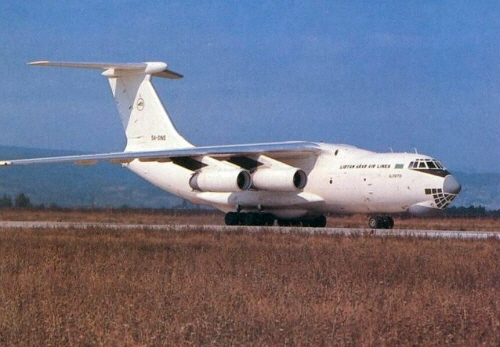
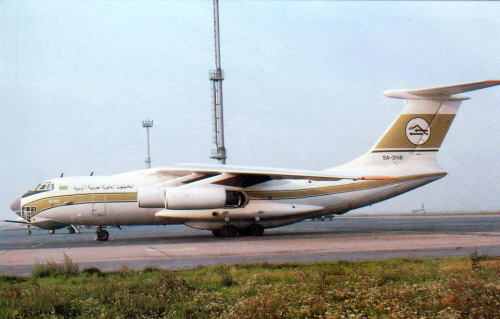
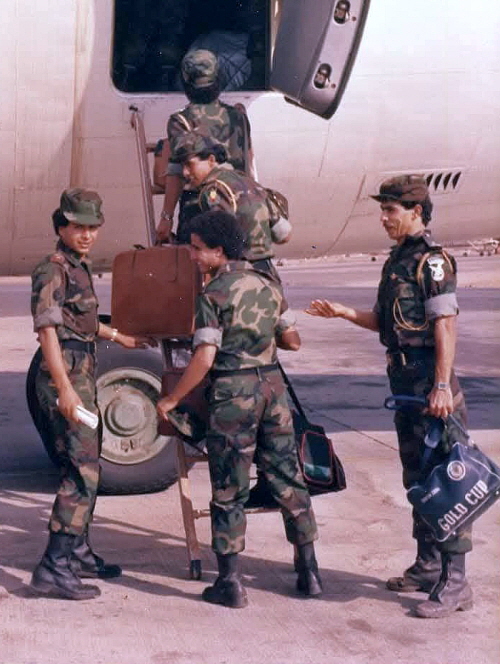
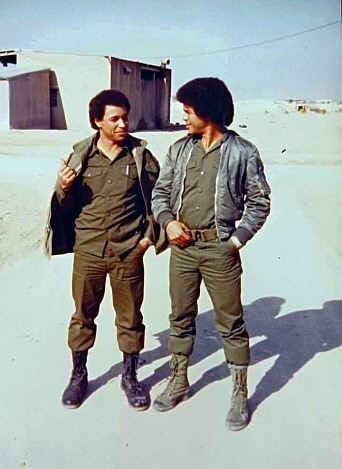
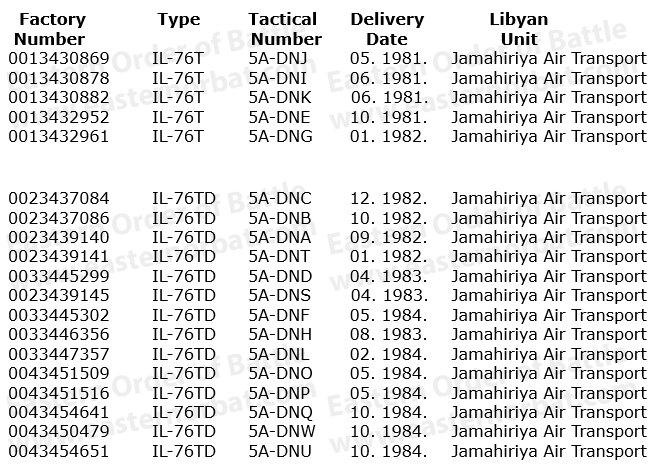
These massive transport aircraft provided the logistical backbone for Gaddafi’s foreign policy in Africa and the middle-east region during the 1980s and 1990s. In the first half of the 1980s, Libyan IL-76 transport aircraft were already appearing in various parts of the world. They transported aircraft to Nicaragua in South America, soldiers to Lebanon in the Middle East. Spare parts and weapons from France and Czechoslovakia to Libya, and weapons to several countries in the Sahel region of Africa.
Similar to the Soviet Union’s IL-76 ‘Candid’ fleet, which flew under civil Aeroflot markings, these aircraft also did not use military markings. All new Libyan IL-76T/TD versions flew under the civilian markings of Jamahiriya Air Transport, initially in white, and then some were gradually repainted in the colors of Libyan Arab Airlines in end of the eighties.
In addition to military and political missions, Jamahiriya Air Transport also performed real civilian transport operations. In the 1980s, it received civilian Lockheed L-100 Hercules and originally military AN-26 ‘Curl’ transport aircraft too to carry out its missions.
Libyan Arab Air Force aviation units at Tripoli International Airport in the mid-1980s:
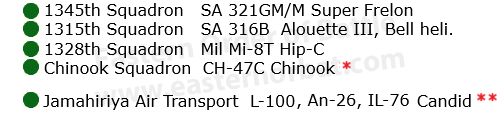
* Under the subordination of the Libyan Army.
** Include the 1276th Squadron
The units stationed at Tripoli International Airport also participated in the In the Libyan-American incidents of 1985 and 1986.
-
The 1345th and 1315th Squadrons performed SAR missions during military incidents with Super Frelon and Alouette III helicopters. Although the shortage of spare parts caused many problems.
-
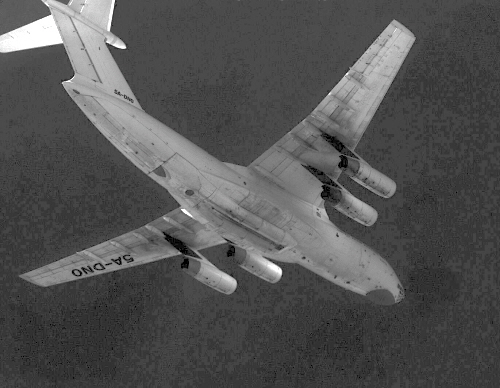
Meanwhile, the 1276th Squadron flew reconnaissance patrol missions over the Libyan coast using long-range, civilian-registered IL-76s, find and tracking the positions of U.S. Navy aircraft carriers. The IL-76’s Kupol navigation system’s radar was used to track American naval units.
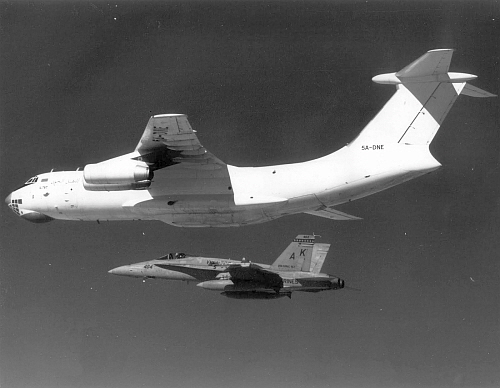
Libyan IL-76T Candid (B/N: 5A-DNE) escorted with VMFA-323 F/A-18A Hornet in 1986 over Libyan coast. Photo: US NAVY
The 1276th Squadron’s IL-76TD ‘Candid’ (B/N: 5A-DNO) flew reconnaissance patrol missions over the Libyan coast in 1986. Photo: US NAVY
Then came Operation El Dorado Canyon, which has been the subject of several misunderstandings in many Western publications. The main error is that many accounts - for example Wikipedia - confuse which Tripoli airport was targeted by U.S. forces. On April 15, 1986, the six F-111F bombers were sent against Tripoli International Airport, not Mitiga (ex. Wheelus Air Base) Airport. Although most of the military units were stationed at the latter, and both were located in Tripoli, the capital. But in reality, these are two different airports located 18 miles (29 km) apart.
Of the six USAFE F-111F Aardvark tactical bombers, due to technical and other problems, only one(!) was able to bomb Tripoli International Airport! That one, however, was very successful. According to U.S. intelligence, it destroyed two/four Libyan IL-76 ‘Candid’ transport planes in a single strike with Mk.82 bombs equipped BSU-49 air inflatable retard fins!
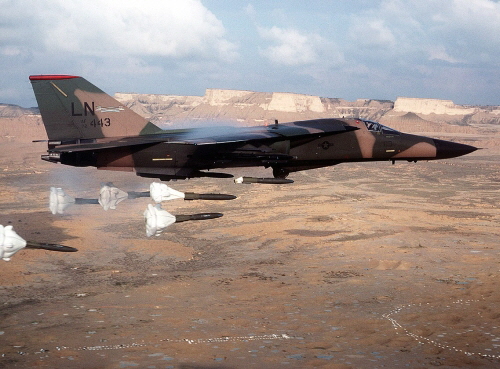
The USAFE 48th Tactical Fighter Wing planned to strike Tripoli International Airport with six F-111F Aardvark tactical bombers during the Operation El Dorado Canyon on 15 April 1986:
-
Puffy-11 destroyed Libyan two IL-76TD cargo airctaft
-
Puffy-12 technical problem, aborted mission after last air refueling
-
Puffy-13 technical problem, missed the bombs fell into an open field
-
Lujac-22 missed the target
-
Lujac-23 missed the target
-
Lujac-24 technical problem, missed the bombs fell into an orange grove
Video
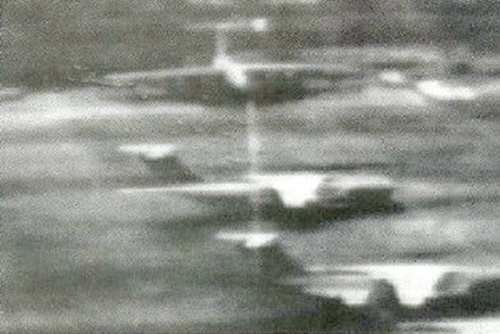
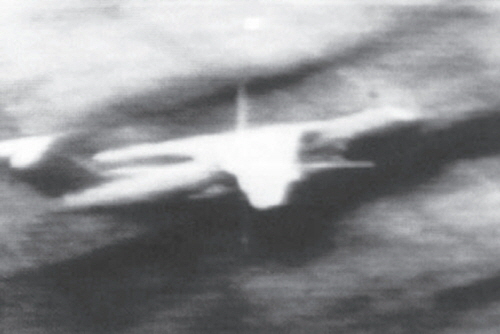
The USAFE 48th Tactical Fighter Wing's F-111F Aardvark tactical bomber (callsign: Puffy-11) strike to Tripoli International Airport during the Operation El Dorado Canyon on 15 April 1986 night with the AVQ-26 Pave Tack FLIR system.
Libyan sources mention similar losses on April 15, 1986, but with greater precision.
-
During Operation El Dorado Canyon, two Libyan IL-76TDs (B/N: 5A-DNF and 5A-DNL) were indeed destroyed.
-
One IL-76TD (B/N: 5A-DNW) was damaged. It was repaired on-site to the extent that it could fly to the Soviet Union via Prague for major repairs in 1987. There, it was scrapped for unknown reasons and never returned to Libya.
-
Meanwhile, the fourth aircraft, an IL-76M (B/N: 5A-DMM), sustained only minor damage, which was repaired on-site. This IL-76M aircraft transported the remains of Fernando Ribas-Dominici, the pilot of the shot-downed USAFE F-111F, back to Italy in 1989.
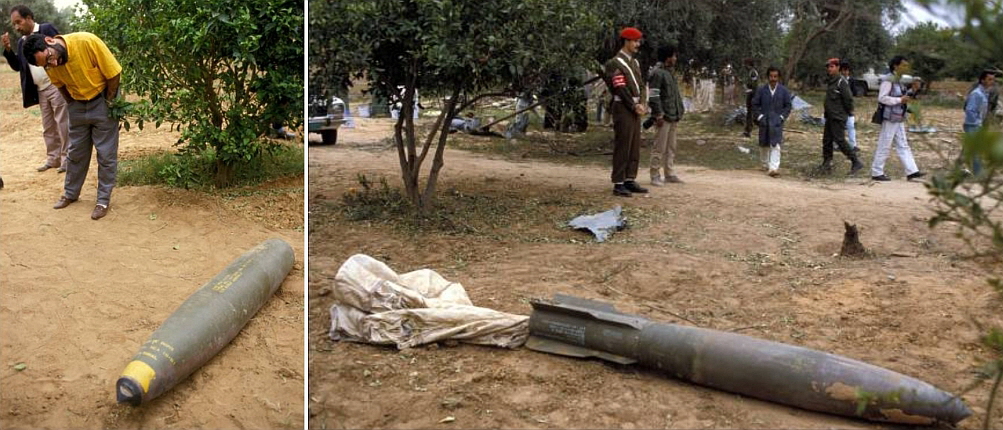
The USAFE F-111F’s (callsign: Lujac-24) Mk.82 bombs that missed their targets and failed to explode in Tripoli. Photo: Bernard Bisson
The aviation squadrons of Tripoli International Airport were actively involved in the Chadian conflict during the second half of the 1980s.
The Libyan Arab Air Force’s IL-76 ‘Candid’ heavy transport aircraft participated in the conflict from 1980 until the end of the Libyan-Chadian War in 1991. They transported weapons, supplies, and soldiers to the conflict zone. These Soviet-designed heavy transport aircraft were capable of operating from the metal-sheet-covered runways at the Ozo and Ouadi Doum airfields. For the returning soldiers, these were the birds of freedom that brought them back to home.
After March 1987, the Libyan IL-76s were assigned a special mission. After the loss of the Ouadi Doum airfield in Chad, a large amount of Soviet-origin military equipment remained at the airfield and in the surrounding area. The Libyan Arab Air Force was tasked with destroying these, and it deployed the IL-76s for the mission too. The Libyan IL-76s transport aircraft disgorged bombs out of their rear loading ramp while flying over the Ouadi Doum airfield in Chad.
During the war, the 1276th Squadron suffered the loss of a single aircraft. On August 8, 1987, the ‘5A-DLL’ IL-76M took off from Ozo Airport, which was under enemy fire. In the hurry, the altimeter was not reset, so the 5A-DLL collided with the ground near Sabha before reaching its destination airport.
The army’s operations were primarily supported by Italian-made CH-47C Chinook helicopters, but in the second half of the 1980s, the Mi-8T ‘Hip-C’ helicopter type also appeared over the battlefields.
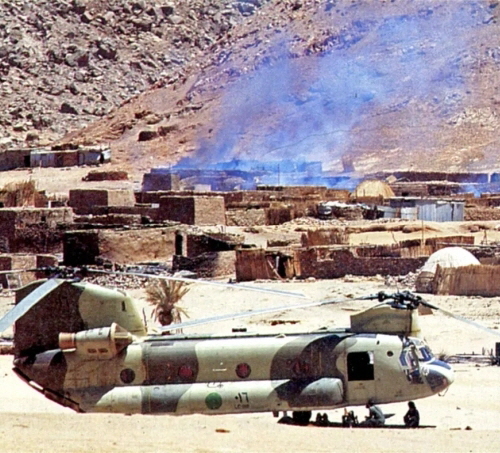
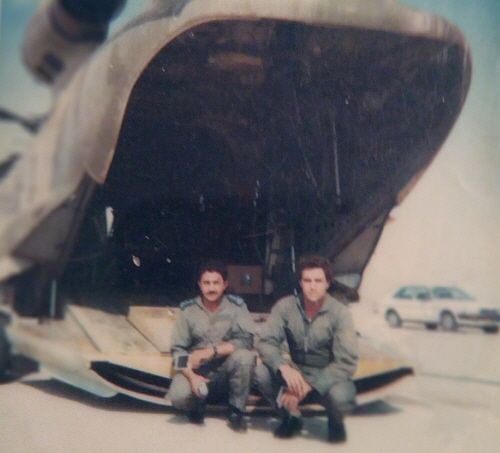
The workhorse of the Libyan Army in Chad: the CH-47C Chinook heavy helicopter type
A third part is also expected!
Tags:
Libyan Air Force, Libyan Arab Republic Air Force, Libyan Arab Air Force, LAAF, Cold War, Libyan Air Force order of battle, Tripoli International Airport, Tripoli Idris International Airport, RAF Idris Airport, RAF Castel Benito Airport, Tripoli-Castel Benito Airport, Tripoli IAP, 1345th Squadron SA 321M Super Frelon Tripoli International Airport, Libyan search and rescue missions, 1345th Squadron SA 316B Alouette III, AgustaBell 205 helicopter Tripoli International Airport, Libyan SAR, Libyan Chinook Squadron Meridionali-Boeing CH-47C Chinook Tripoli International Airport, Chad, Libyan 1276th Squadron Ilyushin Il-76M Candid Tripoli International Airport, 1345th Squadron SA 321GM Super Frelon Tripoli International Airport, Libyan search and rescue missions, 1328th Squadron Mi-8T Hip-C Tripoli International Airport, Jamahiriya Air Transport Ilyushin Il-76T Candid Tripoli International Airport, Jamahiriya Air Transport Ilyushin Il-76TD Candid Tripoli International Airport, Operation El Dorado Canyon 48th Tactical Fighter Wing's F-111F Aardvark, callsign: Puffy-11, Tripoli International Airport, Chadian conflict, Chad, Chadian–Libyan War, Chadian–Libyan War, Libyan Conflicts, Toyota War, Gaddafi, Operation El Dorado Canyon, Libya–Russia relations, France–Libya relations, Tripoli International Airport, Tripoli Idris International Airport, RAF Idris Airport, RAF Castel Benito Airport, Tripoli-Castel Benito Airport