FLAG

Libyan Air Force order of battle
between 1983 and 1987
Draft site
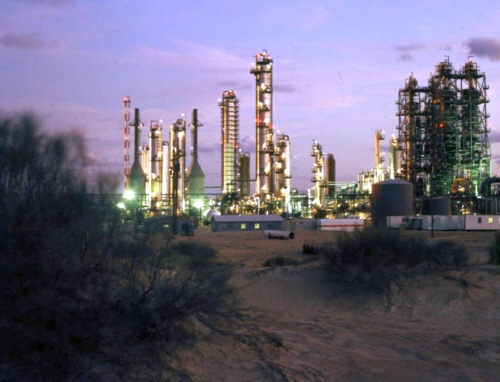
The U.S. Government designated Libya a "state sponsor of terrorism" on December 29, 1979. Later in March 1982, the U.S. Government prohibited imports of Libyan crude oil into the United States. Since the economy of Libya depended primarily on revenues from the petroleum sector this affected the Libyan economy sensitively.
While Libya had previously paid for weapons in cash, by the early 1980s it could only arm itself through loans. There was no longer talk of fighters bought by the hundreds, as in the second half of the seventies. In addition, France also announced weapon embargoes too from 1983. Therefore, in the first half of the eighties, they could only order air defence weapons in much smaller quantities and those only from the Soviet Union.
The Soviet Union also only handed over for defense purposes weapons for defensive purposes! Between 1983 and 1985, it delivered
-
about fifty MiG-25PD, MiG-23MLD (MLAE-2) interceptor fighter aircrafts
-
seven battalions SA-75M Volhov and ten battalions S-125M Neva/Pechora air defense missile systems
-
and S-200VE Vega-E long-range, high-altitude surface-to-air missile systems
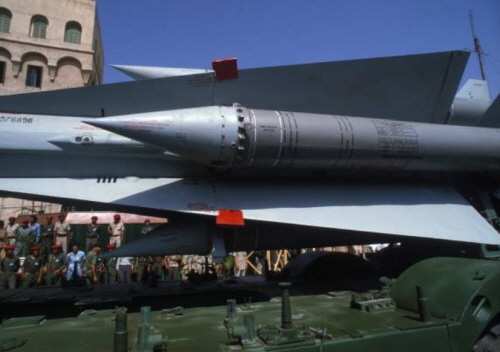
V-880E/5V28E missile of S-200 air defence system at the 1987 military parade in Tripoli. The Soviet Union delivered four missile battery to Libya in 1985. The first two S-200VE Vega-E battery were assigned to the HUN Air Defense sector SAM group. The other two were assigned to the Benghazi Air Defense sector.
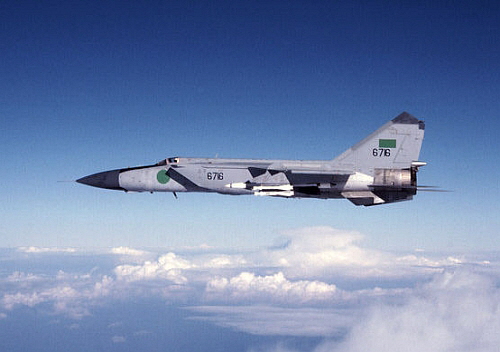
In 1984, twelve MiG-25PD ‘Foxbat-E’ variants arrived in Libya. The newly formed 1055th Squadron received these modern interceptors at Mitiga Airport, then moved to Ghardabiya Air Base in 1986. Photo: US NAVY
To control the the newly purchased air defense systems, Libya also bought two 5Sz99E Senezh-E automated air defense control systems from the Soviet Union in 1985. The 5Sz99E Senezh-E, as a management system handles the coordination of the subordinated air defense assets at one air defense brigade level. This automated air defense control system could track 50 aerial targets at once and was able to simultaneously guide seventeen SA-75, S-125 or S-200 target channels and six MiG-23 or MiG-25 interceptor fighter planes to the enemy air target.
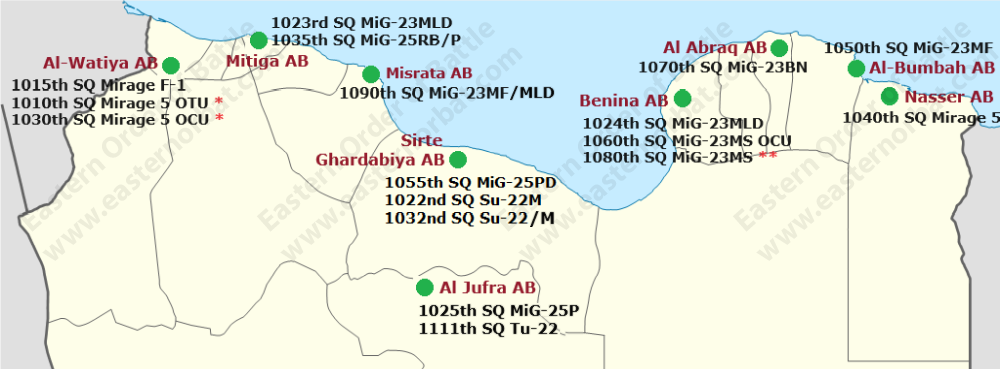
The order of battle for high-speed Libyan aircraft in 1987. Between 1982 and 1987, there were few changes. In 1983 a new, larger airport was opened, the Al-Jufra air base. In addition, three new fighter squadrons were established in 1984 - 1055th. 1023rd, 1024th Air Squadrons.
* It is not known whether
these were merged.
** With Syrian crew
Although the above air defense forces are impressive, on the night of the El Dorado Canyon on April 14, 1986, the Libyan command did not send its the Libyan interceptor force into battle. Although Libyan fighter jets patrolled the skies all day on the 13th, they were not given orders to take off on the night of the attack!
Only the air defense missile units remained, whose the skills of Libyan personnel had not yet reached the required level by 1986. Years of Soviet training for SAM, radar and control systems operators did not provide them with sufficient experience to handle more complex electronics.
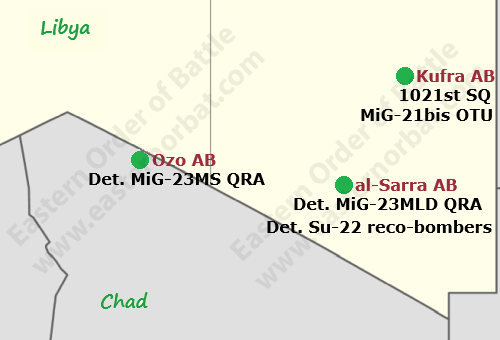
The high-speed Libyan aircraft were deployed too in southern Libya during the Chadian War. The types of aircraft stationed here were constantly changing. Between September 1 and 5, 1987, the following order of battle was in place on the Libyan-Chadian border.
The border airspace was guarded by the older MiG-23MS 'Flogger' (with crew of 1060th and 1090th Squadrons) and MiG-23MLD 'Flogger' (with crew of 1023rd and 1024th Squadrons) fighter aircraft. Su-22 'Fitter' types (with crew of 1022nd and 1032nd Squadrons) performed reconnaissance and bombing missions.
Tags:
Libyan Air Force, Libyan Arab Republic Air Force, Libyan Arab Air Force, LAAF, Cold War, Libyan Air Force order of battle between 1983 and 1987, 1015th Squadron Mirage F1AD Mirage F1ED Mirage F1BD Al-Watiya airbase, 1030th Squadron Mirage 5 Okba Ibn Nafa Air Base airport, 1010th Squadron Mirage 5 Al-Watiya airport, 1023rd Squadron MiG-23MLD Flogger Mitiga airbase, 1035th Squadron MiG-25RBK Foxbat-B, MiG-25P Foxbat-A Okba Ben Nafi airfield, 1090th Squadron MiG-23NF Flogger-B MiG-23MLD Flogger Misrata airbase, Ukba Ibn Nafi airport, 1022nd Squadron Su-22M S-52K Ghardabiya Sirte airbase, 1032nd Squadron Su-22 S-32M2K Ghardabiya Sirte airbase, 1055th Squadron MiG-25PD Foxbat-E Al-Qarzabiya airbase, 1025th Squadron MiG-25P Foxbat-A Al-Jufra airbase, 1025th Squadron Tu-22 Badger Al-Jufra airbase, 1024th Squadron MiG-23MLD Flogger Benina airbase, Benghazi, 1060th Squadron MiG-23MS Flogger-E Benina airbase, Benghazi, 1080th Squadron MiG-23MS Flogger-E Benina airbase, Benghazi, Syrian crew and pilots, 1080th Squadron MiG-23MS Flogger-H Benina airbase, Benghazi, 1070th Squadron MiG-23BN Flogger-H Al-Abraq, 1050th Squadron MiG-23MF Flogger-B Shahid Ali Rais Base, Bombah, Martyr Ali Al-Rais, 1040th Squadron Mirage 5 Gamal Abdel Nasser airport, Tobrik airport, 1021st Squadron MiG-21bis Fishbed-L Kufra Air Base, Su-22 Fitter, MiG-23MLD Flogger Maaten al-Sarra airport, MiG-23MS Flogger-H Aouzou air Strip, Ozo airport, Chad, Chadian–Libyan War, Chadian–Libyan War, Libyan Conflicts, Toyota War, Gaddafi, Operation El Dorado Canyon, Soviet-Libya relations, France–Libya relations